Русский
 English

Why Turnout Slide Baseplates Fail and What to Check Before Replacement
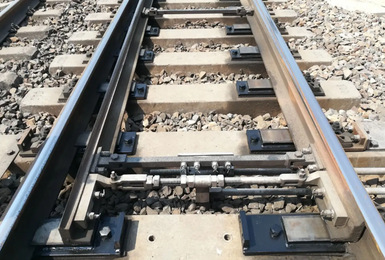
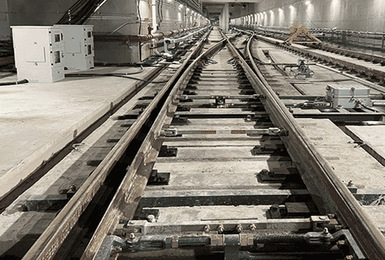
Turnouts in ballasted track and concrete track beds
When we receive an enquiry about a cracked or worn slide baseplate, our first questions concern the damage location and the condition of the installed assembly. Slide baseplate failure can involve a connection, the plate body, a contact surface or the support beneath the plate. Similar visible damage can have different contributing factors, so the scope of the problem should be recorded before a replacement is purchased.
Identify Where the Slide Baseplate Is Damaged
Connection Cracks and Cracks in the Plate Body
Cracks or separation at the connection between the slide chair and baseplate should be recorded separately from cracks in the middle of the plate or near mounting holes. For connection damage, check the joint and the forces acting on it. For plate body cracks, also consider plate bending, local support and the fastening condition. Slide baseplate weld cracking describes damage at a connection; it does not, by itself, establish that the material is nonconforming.
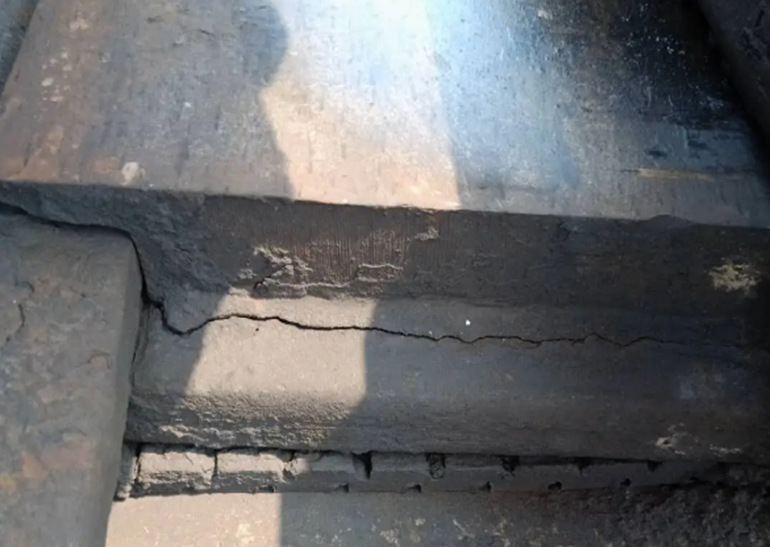
Separation at the connection between the slide chair and baseplate
Retaining Lip Damage and Sliding Surface Scratches
A chipped or cracked retaining lip, surface grooves, corrosion and embedded debris are different defects. Retaining lip inspection should take account of where it contacts the stock rail. When recording slide chair plate wear, note the extent and direction of the wear marks and the condition of adjacent plates. If turnout operating resistance has increased, the associated equipment also needs to be checked; surface roughness should not be assumed to be the sole cause.
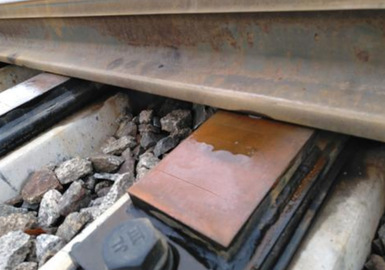
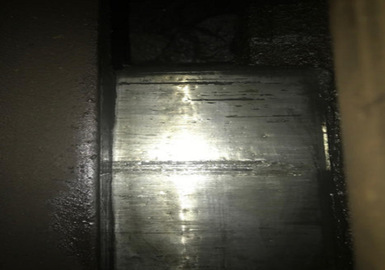
Corrosion and scratches on existing slide baseplate sliding surfaces
Start with photographs that show the damage in relation to the whole plate, then add close-ups with a scale. Record whether the damage affects one plate, several adjacent plates or the same plate position repeatedly. Include the discovery date and any work already carried out. Close-up photographs taken only after removal can omit the original support and contact conditions, making it harder for a supplier to assess the replacement requirements.
How Repeated Loading Can Worsen Local Weaknesses
As trains pass, loads transfer through the rails, supporting components and underplate pads. If contact is concentrated over a small area, or the plate repeatedly flexes under passing loads, joints and changes in section may experience adverse cyclic loading. Assessing fatigue damage requires the location, structural details and service records. A photograph of a crack cannot establish the complete cause, and a supplier's illustrative formula should not be used on its own to calculate remaining service life.
When damage recurs at the same position, review whether abnormal support or contact conditions remained after the previous replacement, as well as the quality of the new component. If damage is concentrated in one turnout area, review the installation and maintenance records for that area. Plates in different positions or at different stages of service cannot be compared for durability solely by the number of months they have been installed.
Check the Underplate Support and Fastening System
Local Shimming and Pad Condition
Local shims, displaced pads, loss of pad resilience or support gaps can change plate-to-support contact and load distribution. Record the shim locations, the combinations used and any differences in bearing surface height. Select height adjustment pads for the specific system and measured conditions. Temporary local shimming should not replace an approved support arrangement.
Rail Contact and Fastening Condition
Insufficient contact between the stock rail and retaining lip, abnormal fastener condition or changes in turnout geometry may also increase local impact. Check the assembly condition of the complete fastening system and associated rails. Simply applying greater fastening force is not an adequate response; torque and geometry limits must come from the relevant design or maintenance documents.
| Observed condition | Related conditions to check | Records to retain |
|---|---|---|
| Connection cracks or separation | Joint and support condition | Crack location and overall and close-up photographs |
| Baseplate cracks or fracture | Local shimming, gaps and plate deformation | Plate-to-support contact and pad arrangement |
| Retaining lip damage or side wear | Stock rail contact and turnout geometry | Contact marks and the corresponding plate position |
| Grooves, corrosion or embedded debris | Contamination sources, contact and maintenance condition | Surface photographs and maintenance records |
Discuss Your Slide Baseplate Replacement
Support System Issues in the Chengdu Metro Investigation
Existing field investigation records describe an inspection of a P60-9 turnout at Tianfu Square station in Chengdu on 3 June 2020. The records identify uneven bearer levels, inconsistent local shimming, displaced rubber pads and loss of pad resilience, together with issues involving frame dimensions and stock rail contact. The investigation linked these site conditions to uneven slide baseplate loading and connection damage.
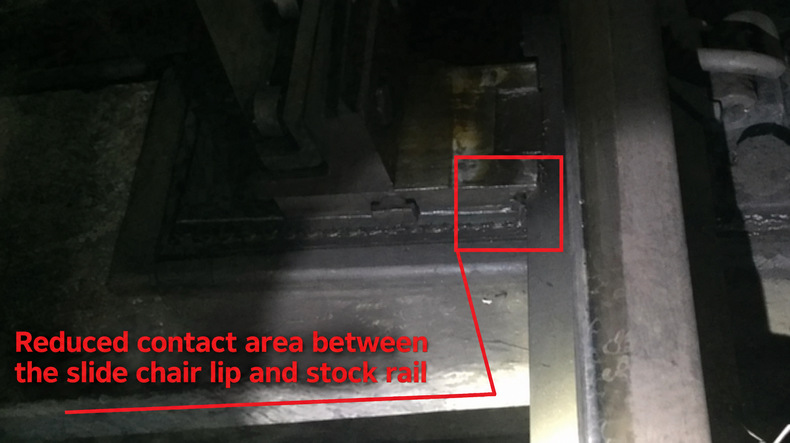
Field record of reduced contact between the stock rail and slide chair in the Chengdu case
The supplier's proposed solution combined one-piece cast slide baseplates with tapered height-adjustment pads, rail braces and underplate pad changes. The case illustrates why the inspection scope should include the support system as well as the plate itself. The material does not provide verifiable long-term acceptance data, so it cannot support a promise that similar sites will achieve the same service life.
For buyers, the case raises three practical questions. Have the differences in site levels been measured? Will the existing pads be retained? Will the new plate and associated components change the relationship between the fasteners and stock rail contact? Do not copy pad thicknesses or geometric dimensions from the case into an order. Submit the measurements for your own project to the responsible design and technical personnel for confirmation.
What a Replacement Slide Baseplate Can Address
ASAN supplies one-piece cast slide baseplates to address weld separation, sliding surface wear and corrosion. We supply components for new turnout installations, spare parts procurement and the replacement of existing plates on railways and urban rail systems.
The one-piece body eliminates the structural weld between the slide chair and baseplate, reducing the risk of separation at that joint. A locally treated wear-resistant surface addresses wear and corrosion at the working area. For replacement projects, we check the interfaces and associated components against the original drawings, damage photographs and support conditions to provide a stronger, more durable replacement solution.
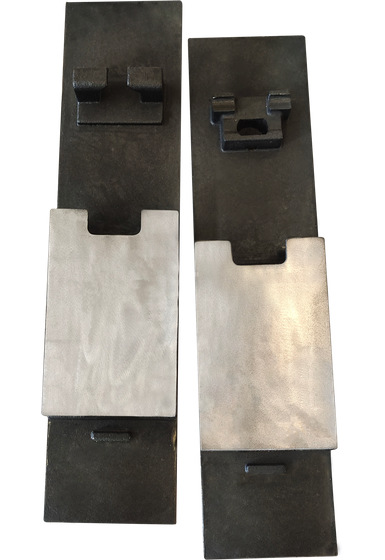
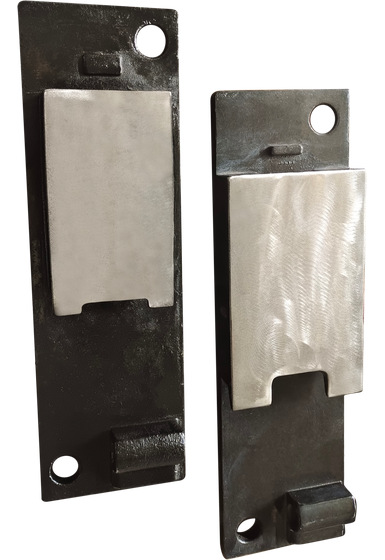
ASAN one-piece cast slide baseplates and their working surfaces
Features of the ASAN Cast Slide Baseplate
The product uses a 20SiMn cast steel body to balance load-bearing performance and toughness. The comparison material reports higher tensile strength, yield strength and impact test values for the ASAN design than for the conventional comparison samples.
Wear treatment is concentrated on the surface contacted by the moving switch rail. The retaining lip does not receive the same hardening treatment, preserving the toughness needed in that area. This zoned design balances sliding surface wear resistance with retaining lip toughness and can be evaluated for renewal projects involving wear and corrosion.
ASAN Cast Slide Baseplate Performance Comparisons
The following two performance comparison datasets are presented separately, as in the source material.
Experimental Comparison Group
| Test item | Conventional comparison sample | ASAN cast slide baseplate | Relative improvement with ASAN |
|---|---|---|---|
| Tensile strength MPa | 370 | 510 | 37.8% higher |
| Yield strength MPa | 235 | 295 | 25.5% higher |
| Impact test value J | 27 | 39 | 44.4% higher |
| Sliding surface hardness HBW | 156 | 350 | 124.4% higher |
| Sliding surface salt spray test 96 h | Extensive corrosion | Protection rating 9 | Improved protection |
Application Comparison Group
| Test item | Conventional comparison sample | ASAN cast slide baseplate | Relative improvement with ASAN |
|---|---|---|---|
| Tensile strength MPa | 375 | 540 | 44.0% higher |
| Yield strength MPa | 224 | 310 | 38.4% higher |
| Impact test value J | 28 | 56 | 100.0% higher |
| Sliding surface hardness HBW | 148 | 510 | 244.6% higher |
| Sliding surface salt spray test 96 h | Extensive corrosion | Protection rating 9 | Improved protection |
Both tables in the original material are labelled "theoretical data". Order acceptance must be based on the applicable product model, inspection reports and technical agreement. Percentage increases are calculated from the values within each comparison group. No percentage increase is calculated for salt spray performance, and the salt spray results are not converted into years of corrosion protection or service life in the field.
When selecting a slide baseplate replacement, also check hole positions, working height, plate position, handedness and the associated fasteners. A new cast plate cannot correct an uneven bearing surface, failed pads or incorrect assembly. Those issues need to be included in the same remedial plan.
Records to Prepare Before Ordering Replacements
Retain the original part drawing number and revision, turnout model, plate position and handedness. Take overall photographs before removal, close-ups of the damage and photographs of the support beneath the plate. Record hole positions, working height, the pad arrangement and any known abnormalities. Checks under load and dismantling or reassembly must be organised by authorised personnel under the railway's procedures. This article does not authorise on-site weld repair or a return to service.
The enquiry should distinguish individual plate replacement from a coordinated remedial package. Identify the components to retain, the components to replace and any items that still need to be checked. If an interface cannot be confirmed from photographs, provide approved drawings or measurements of the actual component. This information allows the supplier to define the scope of supply, while the site technical team confirms that the remaining issues are covered by the remedial and acceptance plan.
ASAN can review the supply requirements for replacement slide baseplates using your drawings and damage photographs. Our turnout maintenance projects provide context for the wider maintenance scope; the specific work must follow the project's approved plan. Send your information to info@tyjx.info and state which associated components you intend to retain.
We receive enquiries in English, Español (Spanish), Русский язык (Russian), Français (French) and العربية (Arabic). Our professional team will reply to you within one business day. Please feel FREE to contact us!
- Rail Fastener System
- Rail Fastening System
- Hey Back Rail Fastening System
- RNY/ NY-GN Spring Blade Rail Fastening System
- Rail Fastening System for Russian Speaking Countires
- Rail Fasteners
- Rail Joints
- Rail Clips
- Dog Spike
- Track Bolt
- Screw Spike
- Rail Clamp
- Railroad Frog Bolts
- Metro Bolt
- Chairs And Keys In Railway
- Russian Rail Clip
- Russian Rail Clamp
- Rail Track Parts
- Tie Plate
- Hook Twin Tie Plates
- Rail Anchor
- Rail Pad
- Rail Shoulder
- Rail Gauge Rod
- Height Adjustment Pad
- Rail Sleepers
- Concrete Sleeper
- Composite Sleepers
- Wooden Sleeper
- Railroad Ties
- Wooden Sleeper Gang Nail
- Plastic Sleeper
- Railway Turnout Components
- Others