 Русский
 English

Cast vs Welded Slide Baseplates for Railway Turnouts
Slide baseplates support and restrain the stock rail in a railway turnout while providing a sliding surface for the lateral movement of the switch rail. Depending on the design and manufacturing process, these components are typically fabricated by welding steel parts together or produced as castings.
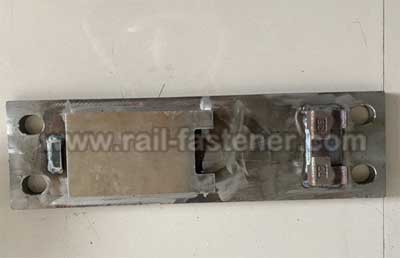
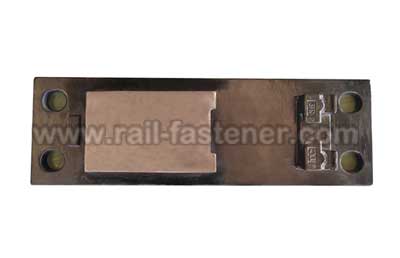
Welded slide baseplate | Cast steel slide baseplate
The two manufacturing methods differ in their construction, material selection, machining requirements and quality control. For new turnout installations, maintenance and replacement projects, buyers need to assess dimensional compatibility, surface treatment requirements and inspection evidence alongside the manufacturing method and visible condition of the product.
In this article, we compare cast and welded slide baseplates from an engineering and procurement perspective to help you evaluate products and select a suitable replacement.
Essential Functions of a Turnout Slide Baseplate
Whether welded or cast, a slide baseplate must meet the support, fastening and sliding requirements of the turnout. Both types have the same core functions: to support and restrain the stock rail, and to provide a reliable sliding surface for the switch rail as the turnout changes position.
Stock Rail Restraint and Switch Rail Support
1. Supporting and restraining the stock rail
The stock rail is the fixed rail in a turnout. The slide baseplate supports and restrains it through the bearing surface, retaining features and associated fasteners or fixing arrangements. The exact configuration depends on the turnout design. Its purpose is to keep the stock rail in its specified position and limit unwanted lateral movement and rotation.
2. Supporting the switch rail during movement
The switch rail is the movable rail that shifts laterally when the turnout is operated. Its foot moves across the sliding surface of the baseplate. This surface must therefore meet the specified geometry, flatness and surface quality requirements so that the switch rail can move correctly without excessive sliding resistance or wear.
3. Requirements shared by both constructions
Both welded and cast slide baseplates need sufficient structural strength and dimensional accuracy to support the rail components and transfer loads through the plate and its connections to the turnout bearer below. The installation position and critical dimensions must also conform to the turnout design to maintain the correct relationship between the stock rail and switch rail.
The sliding surface and the stock rail restraint perform different functions, so their material properties, strength and surface treatment requirements may differ. This distinction is important when comparing the two constructions.
Structural Differences Between Welded and Cast Slide Baseplates
The main difference lies in how the body is made and how its structural features are connected. A welded slide baseplate is generally assembled from several machined steel components, whereas a one-piece casting incorporates multiple structural features in a single casting. Each method has its own manufacturing requirements and quality control priorities.
Welded Joints and Areas Susceptible to Fatigue
A welded slide baseplate typically consists of a baseplate, slide chair and retaining features made from separate steel components. The individual parts are welded together to form the complete assembly, with the exact arrangement determined by the product design.
Welds require particular attention. Local stress concentrations can occur at the weld toe or root, while the heat-affected zone may undergo changes in microstructure and material properties. Welding residual stresses and distortion can also affect dimensional accuracy. Under repeated service loads, an inadequately designed or poorly controlled weld may become a starting point for fatigue cracks.
The quality of a welded slide baseplate therefore depends on the weld design and manufacturing process as well as the parent material. When purchasing, review the welding procedure specification (WPS), welder qualifications, visual and dimensional inspection records, and any non-destructive testing (NDT) reports required by the project. Common methods include visual testing (VT), magnetic particle testing (MT) and ultrasonic testing (UT). The appropriate method depends on the joint configuration and acceptance requirements.
Casting Quality Machining and Material Grade
A one-piece cast slide baseplate can combine the base, sliding platform and certain retaining features in a single casting, reducing the welded connections between them. Casting the body in one piece does not eliminate manufacturing defects, so casting quality still requires strict control.
Common casting quality issues include:
- Shrinkage cavities
- Porosity
- Inclusions
- Cracks
- Dimensional deviations
These issues must be assessed according to their location, size and nature, together with the applicable product acceptance criteria. The name of a defect alone does not establish its effect on the component.
Buyers should also distinguish cast steel from cast iron. These are different material categories with significantly different mechanical properties. Cast steels are available in different strength and toughness grades, while cast irons include grey iron, ductile iron and other types. Actual performance depends on the grade, chemical composition and heat treatment condition. Check the specified material grade, mechanical properties and supporting material certificates rather than treating all cast materials as equivalent.
After casting, slide baseplates normally require machining, particularly on the sliding surface, mounting holes and other critical mating features. Dimensional accuracy, machining quality and surface condition at these locations directly affect compliance with the drawings and compatibility during installation.
Design Features of the ASAN One Piece Cast Slide Baseplate
For turnouts affected by separation at welded slide chair joints, sliding surface wear, corrosion or broken retaining lips, changing the manufacturing method is only part of the selection process. The replacement must also be assessed for its structural design, material properties and surface treatment.
At ASAN, we offer a precision cast composite slide baseplate developed through years of research and testing to address these problems. It combines a one-piece cast body with a laser-applied wear-resistant layer on the sliding surface and differential hardening across functional areas. The design addresses structural connections, surface wear resistance and local toughness.
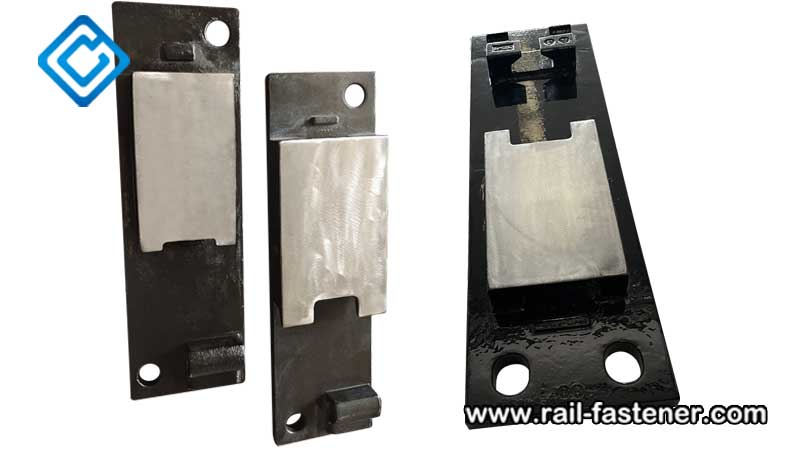
ASAN one-piece cast slide baseplates for railway turnouts
Precision Casting with Fewer Welded Connections
Our manufacturing partner, Henan Tiechuang, produces the main structural features as a single casting, reducing welded connections between the baseplate and slide chair compared with a conventional fabricated assembly.
This construction reduces reliance on critical welded joints and helps lower the risk of slide chair separation associated with welding quality, weld fatigue or insufficient joint area.
The precision casting process also controls the casting microstructure, internal quality and geometry to improve structural soundness, reduce internal stresses and improve dimensional accuracy. This process is an important feature that distinguishes the product from conventional cast slide baseplates.
A Wear Resistant Alloy Layer on the Sliding Surface
The sliding platform is the working area that repeatedly contacts the moving switch rail. Friction, metal debris and exposure to the operating environment can cause wear, scratches and corrosion. These conditions may increase sliding resistance and interfere with normal turnout operation.
Our slide baseplate uses a laser process to apply a hard, wear-resistant alloy layer to the sliding surface, improving surface hardness and resistance to wear.
The layer is designed to provide the following benefits:
- Wear resistance: Reduces working surface wear caused by repeated switch rail movement.
- Scratch resistance: Lowers the risk of metal filings and other debris becoming embedded in the surface and causing scratches.
- Corrosion resistance: Reduces the effect of surface corrosion on switch rail movement.
- Reduced maintenance frequency: Helps lower sliding resistance and reduce the frequency of manual lubrication by maintenance crews.
Compared with a sliding surface machined from conventional steel alone, this composite wear-resistant design places greater emphasis on long-term performance at the contact surface.
Differential Hardening for Wear Resistance and Retaining Lip Toughness
Different parts of a slide baseplate perform different functions, so a uniform high-hardness requirement is not appropriate for every area.
The sliding platform needs surface hardness and wear resistance to withstand contact with the switch rail. The retaining lip restrains the stock rail and needs sufficient toughness and impact resistance.
We use differential hardening to address these requirements:
- Retaining lip: This area is left unhardened to preserve the toughness of the base material and reduce the risk of fracture associated with local embrittlement.
- Sliding surface areas: A hard, wear-resistant alloy material improves surface hardness and resistance to wear.
Treating each functional area according to its requirements balances toughness at critical retaining features with wear resistance at the sliding surface, rather than pursuing high hardness throughout the entire component.
Custom Designs for Site Conditions
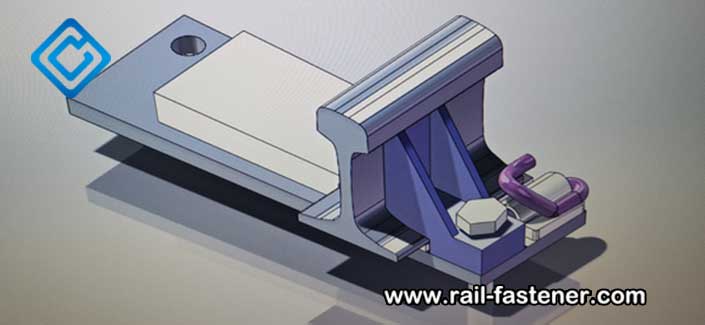
Slide baseplate configuration for specific installation conditions
Turnout models, bearer arrangements, installation conditions and operating environments vary between railway lines. For maintenance and replacement projects, supplying a standard-size slide baseplate may not resolve the structural or installation problems already present on site.
We can adapt the product structure and dimensions using your turnout drawings and site measurement data.
For example, where bearer support surfaces differ in height, tapered height-adjustment pads can be designed from the measured dimensions for use with the corresponding slide baseplates. Where the stock rail is subject to significant overturning forces, an additional rail brace can be evaluated. TPEE underplate pads and bolt cushioning sleeves can also be considered to suit site requirements.
Adapting the plate and its associated components to actual site conditions helps improve load distribution and installation compatibility. Replacing the slide baseplate alone cannot be expected to resolve every track defect.
Verifying Performance Through Testing and Field Use
Structural and material design must ultimately be validated through testing and field use. During development, Henan Tiechuang carried out multiple casting trials and tests on wear-resistant sliding surface materials. Different manufacturing and surface treatment options were compared before the one-piece cast structure and laser-applied wear-resistant layer were selected.
Product Tests and Inspection Records
The testing documentation supplied by ASAN lists the following assessments for the one-piece cast slide baseplate:
- Assembly fatigue testing.
- Tensile strength, yield strength and elongation after fracture.
- Impact toughness testing.
- Metallographic examination.
- Flaw detection and internal defect inspection.
- Destructive testing and dye penetrant testing.
- Salt spray testing of the sliding surface.
Test reports supplied by ASAN record five million assembly fatigue cycles with no cracks found after testing. Comparative test records also report improvements of varying degrees in tensile strength, yield strength, impact toughness and sliding surface hardness compared with conventional slide baseplates.
These results provide evidence for evaluating the material selection, structural design and manufacturing quality. For procurement, review the report applicable to the specific product model, including its test conditions and acceptance requirements.
Request a Slide Baseplate Quote
Metro Project Experience
Our one-piece cast slide baseplates have been supplied for use and trials on several rail projects.
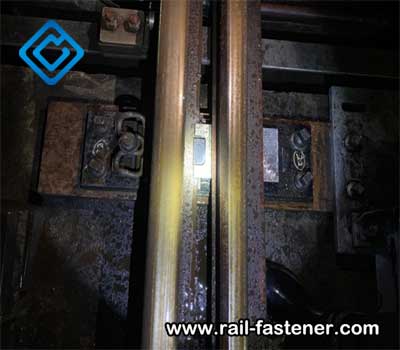
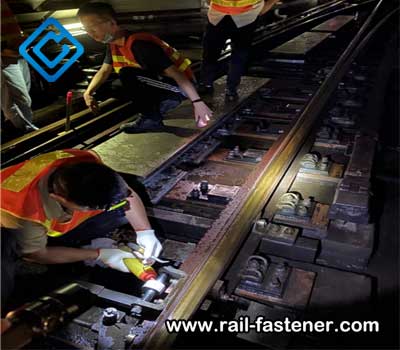
Guangzhou Metro installation site | Guangzhou Metro replacement work
- Guangzhou Metro: Precision cast slide baseplates were supplied to address slide chair separation at welded joints, severe wear and fractures in some existing baseplates. In April 2020, the customer ordered four sets of slide baseplates for reversing turnouts for further field trials. The project records report positive feedback from use.
- Shenzhen Metro: Following discussions with the customer about slide baseplate problems on the Airport North reversing turnouts of Shenzhen Metro Line 1, 12 sets of one-piece cast slide baseplates were trialled. At the time of the source presentation, the trial was still in progress, with positive feedback reported.
- Shanghai Metro: A batch of one-piece cast slide baseplates was supplied to address weld separation and fractures in the existing components. The project records report positive feedback from use.
When to Consider an ASAN Cast Slide Baseplate
If your existing turnout slide baseplates show any of the following problems, the new one-piece cast design from Henan Tiechuang can be evaluated as a replacement option:
- Repeated separation between the slide chair and baseplate: A one-piece casting can reduce welded connections at critical locations.
- Sliding surface wear scratches or corrosion: A composite sliding surface with a laser-applied wear-resistant layer can be considered.
- Repeated fatigue fractures in the retaining lip: Differential hardening can be evaluated to retain toughness in the lip.
- Special turnouts or complex installation conditions: The slide baseplate and associated components can be adapted using site drawings and measurement data.
Suitability as a direct replacement must still be checked against the original turnout model, rail section, mounting dimensions, bearer condition and actual operating conditions.
If you are looking for a replacement for welded slide baseplates, or want to address wear and weld separation in existing turnout components, send ASAN your product drawings, site photographs and technical requirements. Our engineering team can help assess the structure, verify critical dimensions and configure a suitable product.
We receive enquiries in English, Español (Spanish), Русский язык (Russian), Français (French) and العربية (Arabic). Our professional team will reply to you within one business day. Please feel FREE to contact us!
- Rail Fastener System
- Rail Fastening System
- Hey Back Rail Fastening System
- RNY/ NY-GN Spring Blade Rail Fastening System
- Rail Fastening System for Russian Speaking Countires
- Rail Fasteners
- Rail Joints
- Rail Clips
- Dog Spike
- Track Bolt
- Screw Spike
- Rail Clamp
- Railroad Frog Bolts
- Metro Bolt
- Chairs And Keys In Railway
- Russian Rail Clip
- Russian Rail Clamp
- Rail Track Parts
- Tie Plate
- Hook Twin Tie Plates
- Rail Anchor
- Rail Pad
- Rail Shoulder
- Rail Gauge Rod
- Height Adjustment Pad
- Rail Sleepers
- Concrete Sleeper
- Composite Sleepers
- Wooden Sleeper
- Railroad Ties
- Wooden Sleeper Gang Nail
- Plastic Sleeper
- Railway Turnout Components
- Others


